


How Does a PMSM Motor Work? The Core Technology Behind HVLS Industrial Fans
Why PMSM Motors Have Become the Industry Standard for Large Ceiling Fans
If you’ve researched HVLS (High Volume Low Speed) fans, large diameter industrial fans, or big ceiling fans for warehouses and factories, you’ve probably heard the term "PMSM motor" repeatedly. Today, nearly all premium industrial large fans use Permanent Magnet Synchronous Motors (PMSM) as their power source. This isn’t a random trend—it’s because PMSM technology delivers unmatched efficiency, reliability, and performance for low-speed, high-torque applications like HVLS fans.
In this guide, we’ll break down exactly what a PMSM motor is, its core components, and how it works in simple, easy-to-understand terms. No complicated engineering jargon—just clear explanations based on real motor design.
Inside a PMSM Motor: The Two Essential Components
Every PMSM motor for HVLS fans has only two main moving parts (and one of them doesn’t move at all). This simple, robust design is why these motors are so durable and low-maintenance.
1. The Stator: The Stationary Electromagnetic Core
The stator is the fixed, non-rotating part of the motor. It consists of a laminated steel core wrapped tightly with high-purity copper windings. As the name suggests ("stator" comes from "stationary"), this component never moves during operation.
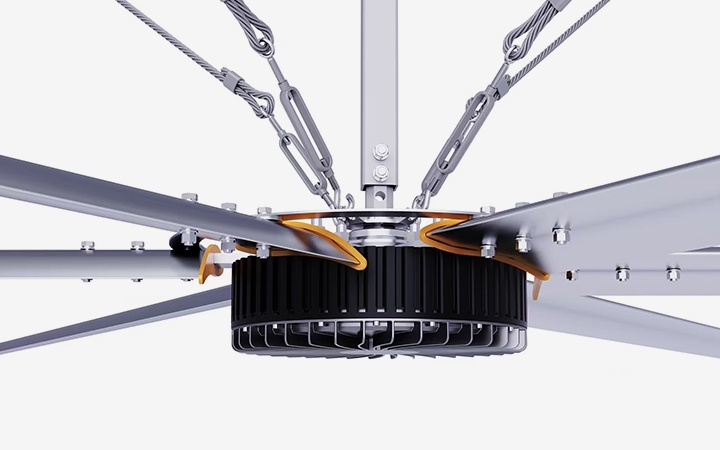
For industrial HVLS fans, the stator is mounted directly to the fan’s central hub and ceiling bracket. It connects to the power supply via four wires: three phase wires (U, V, W) and one ground wire, which deliver the three-phase alternating current that powers the motor.
2. The Outer Rotor: The Rotating Part with Permanent Magnets
This is where PMSM motors differ most dramatically from traditional AC induction motors. Instead of an inner rotor spinning inside the stator, HVLS fan PMSM motors use an outer rotor design.
The rotor is a hollow steel cylinder that fits perfectly around the stator. Attached to the inner surface of this cylinder are multiple high-performance neodymium permanent magnet tiles (magnetic tiles). These magnets create a constant, powerful magnetic field that never fades over the motor’s lifetime.
The fan blades are mounted directly to this outer rotor. When the rotor spins, it turns the entire fan blade assembly smoothly and efficiently.
Step-by-Step Working Principle of a PMSM Motor
The operation of a PMSM motor relies on the interaction between two magnetic fields—one created by electricity, and one created by permanent magnets. Here’s exactly how it works:
1. Three-phase current generates a rotating magnetic field
When three-phase alternating current flows through the copper windings in the stator, it creates a precisely controlled, continuously rotating magnetic field around the stator. The speed of this rotating magnetic field is perfectly synchronized with the frequency of the input current.
2. Magnetic attraction drives the rotor to spin
The permanent magnets on the inner surface of the outer rotor have their own fixed magnetic field. The rotating magnetic field from the stator exerts a strong, consistent magnetic traction force on these permanent magnets.
3. Perfect synchronous rotation
Unlike induction motors (where the rotor always lags behind the magnetic field), the rotor in a PMSM motor spins exactly in sync with the stator’s rotating magnetic field. This synchronous operation is what gives PMSM motors their name and their exceptional efficiency.
4. Continuous, smooth operation
As long as power is supplied, the stator’s rotating magnetic field remains constant. This creates a steady, uninterrupted force that keeps the rotor (and the attached fan blades) spinning smoothly at the desired speed.
Why PMSM Motors Are Superior for HVLS Industrial Fans
The unique design of PMSM motors makes them ideal for large industrial fans, offering significant advantages over traditional AC induction motors:
• 30-50% higher energy efficiency: No energy wasted on rotor slip or secondary currents
• High torque at low speeds: Delivers maximum torque even at 50-150 RPM, perfect for HVLS fan operation
• Ultra-quiet performance: No humming or vibration from rotor slip
• 2x longer service life: Fewer moving parts and less heat generation mean less wear and tear
• Minimal maintenance: No brushes, no commutators, and no need for regular lubrication
• Precise speed control: Allows for infinitely variable speed adjustment to match cooling needs
Conclusion
The PMSM motor is the beating heart of every modern high-performance HVLS industrial fan. Its simple yet brilliant design—combining a stationary copper-wound stator and an outer rotor with powerful permanent magnets—creates the efficient, reliable, and quiet operation that makes large industrial fans the best cooling solution for warehouses, factories, gyms, and other large spaces.
Understanding how PMSM technology works helps you make an informed decision when choosing an industrial fan. Always look for fans equipped with genuine high-quality PMSM motors—they may cost slightly more upfront, but they will save you thousands of dollars in energy and maintenance costs over their lifetime.
Navigation
 How Does a PMSM Motor Work? The Core Technology Behind HVLS Industrial FansApr 24 2026
 Why Do Large Industrial Fans Outperform Small Fans? The Science Behind HVLS TechnologyApr 23 2026
 Complete Maintenance Guide for PMSM Industrial Fans: Ultra-Low Maintenance Cost, 15 Years of Hassle-Free OperationApr 20 2026
 HVLS Large Fans vs Industrial Small Fans: 5 Core Differences for Optimal VentilationMar 20 2026
Send Us A Message