


HVLS Large Fans vs Industrial Small Fans: 5 Core Differences for Optimal Ventilation
When selecting ventilation and cooling solutions for tall and large spaces such as factory workshops, logistics warehouses, large supermarkets, and sports venues, many purchasers ask: What are the core differences between HVLS large fans and industrial small fans? Is it just a matter of size? The answer is far more than that. As a professional manufacturer of Permanent Magnet Synchronous Motor (PMSM) HVLS large fans, today we deeply analyze the essential differences between the two from multiple dimensions including airflow principle, coverage capacity, and energy efficiency, helping you choose the most suitable ventilation equipment.
1. Size and Coverage Area: Dramatic Quantitative Difference
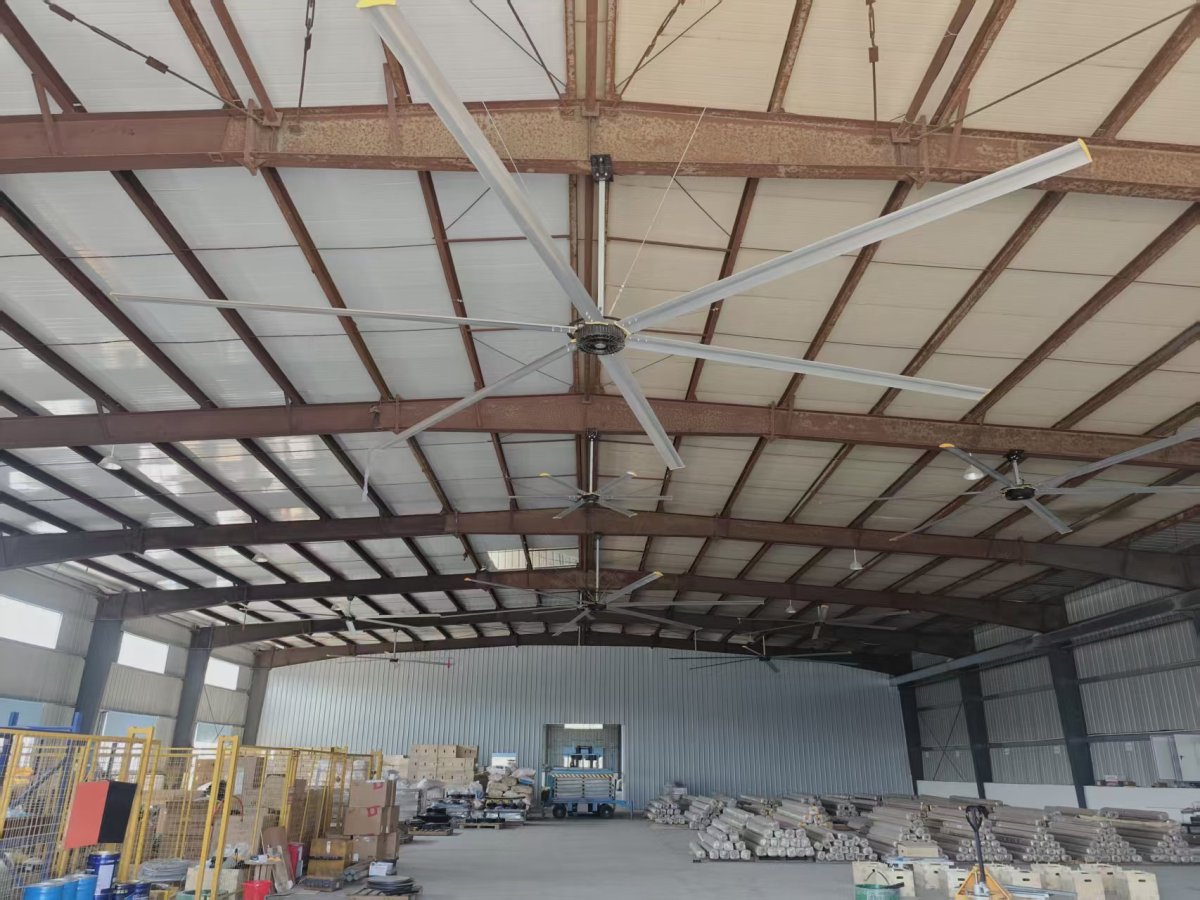
The most intuitive difference is first reflected in size and coverage capacity. Industrial small fans usually have a diameter of only 0.5-1 meters, with an effective coverage area of less than 10 square meters per unit. In contrast, HVLS (High Volume Low Speed) large fans start with a standard diameter of 5.5 meters and can reach a maximum of 7.3 meters.
Take our most commonly used 7.3-meter PMSM HVLS large fan as an example. When installed at a height of 6-12 meters, a single unit can effectively cover an area of 1000-1500 square meters. This means that to cover a 1000-square-meter workshop, you need at least 100 industrial small fans, while only 1 HVLS large fan can achieve comprehensive ventilation.
2. Airflow Pattern and Air Delivery Distance: Completely Different Working Principles
This is the most essential core difference between the two. Industrial small fans rely on high-speed rotation to generate local vertical airflow, with energy concentrated directly below the fan. Beyond 1 meter from the fan, the wind force decays rapidly and disappears, only achieving point-to-point local cooling.
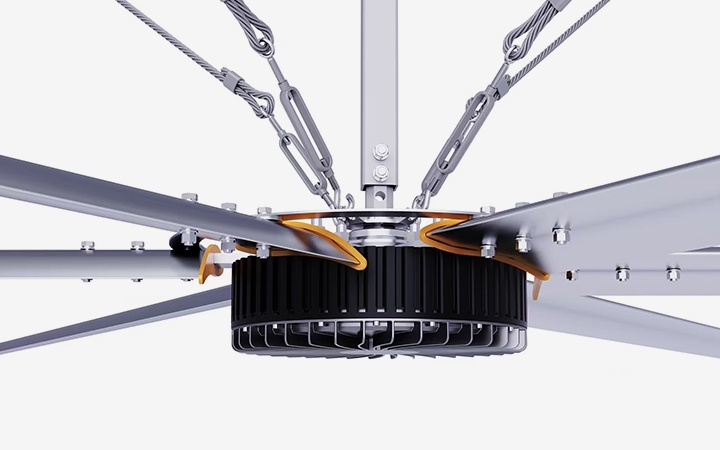
HVLS large fans adopt a unique aerodynamic design. Through the slow rotation of large-diameter blades, they push a large amount of air to flow vertically downward, forming a cylindrical airflow column. When the airflow column reaches the ground, it diffuses horizontally in all directions, forming a continuous horizontal airflow layer of 1-1.8 meters high on the ground, which we call the "horizontal airflow engine".
This unique airflow pattern gives HVLS large fans an amazing air delivery distance: the effective single-side air delivery distance can reach 1.5-2 times the fan diameter. That is to say, a 7.3-meter HVLS large fan can deliver air 15-20 meters to one side, and the airflow can cover every corner of the entire workshop, achieving dead-angle-free comprehensive ventilation.
3. Rotation Speed and Air Volume Efficiency: Large Air Volume at Low Rotation Speed
Industrial small fans generate wind force by high-speed rotation, usually at speeds above 1000 revolutions per minute (RPM). They are noisy, energy-consuming, and produce harsh and piercing wind that can easily cause human discomfort when blown directly for a long time.
In contrast, the operating speed of HVLS large fans is usually only 15-60 RPM. Although the rotation speed is extremely low, they can push tens of thousands of cubic meters of air flow with their huge blade area. Its air volume is not "thrown out" by high-speed rotation, but "pushed out" by large-diameter blades, with extremely high energy utilization efficiency.
This low-speed and large-air-volume design makes the wind generated by HVLS large fans more similar to natural wind, soft and comfortable. It can accelerate the evaporation of sweat on the human body surface, bringing a 3-5℃ body feeling cooling effect, while not producing harsh noise and not affecting the normal production and working environment.
4. Energy Saving Effect and Operating Cost: Significant Long-term Investment Difference
The energy saving advantage of HVLS large fans is unmatched by industrial small fans. A 7.3-meter PMSM HVLS large fan has a full-load operating power of only 1.5kW, consuming less than 1.5 kWh of electricity per hour.
To achieve the same coverage area, you need 100 industrial small fans of 0.75kW each, with a total power of up to 75kW, consuming 75 kWh of electricity per hour. Calculated based on 8 hours of operation per day and 6 months of operation per year, the annual electricity cost of 1 HVLS large fan is only about 2160 yuan, while the annual electricity cost of 100 industrial small fans is as high as 108000 yuan, with an energy saving effect of more than 98%.
In addition, industrial small fans are numerous with complex wiring, resulting in very high installation costs and later maintenance costs. HVLS large fans are installed as a single unit with simple wiring, greatly reducing initial investment and long-term operation and maintenance costs.
5. Maintenance Cost and Service Life: Worry-free and Durable Long-term Choice
As we mentioned earlier, PMSM HVLS large fans adopt a brushless direct drive design, eliminating vulnerable parts such as traditional gearboxes and pulleys. The core motor can operate continuously for 10-15 years under normal working conditions without replacing any parts. It only requires a simple safety inspection before the summer use season every year, with extremely low maintenance costs.
Industrial small fans use traditional brushed motors, with fast-wearing parts such as bearings and carbon brushes. Usually, the motor or accessories need to be replaced every 1-2 years. Moreover, due to the large number, the maintenance workload is heavy, and the long-term maintenance cost is dozens of times that of HVLS large fans.

Conclusion
In summary, the difference between HVLS large fans and industrial small fans is not just about size, but a comprehensive upgrade in airflow principle, coverage capacity, energy efficiency, and user experience. For tall and large spaces with a height of more than 4 meters and an area of more than 100 square meters, PMSM HVLS large fans are the most cost-effective and best-performing ventilation and cooling solution.
If you are looking for suitable ventilation equipment for your workshop, warehouse or commercial space, please feel free to contact us for free on-site survey and customized solutions.
Navigation
 How Does a PMSM Motor Work? The Core Technology Behind HVLS Industrial FansApr 24 2026
 Why Do Large Industrial Fans Outperform Small Fans? The Science Behind HVLS TechnologyApr 23 2026
 Complete Maintenance Guide for PMSM Industrial Fans: Ultra-Low Maintenance Cost, 15 Years of Hassle-Free OperationApr 20 2026
 HVLS Large Fans vs Industrial Small Fans: 5 Core Differences for Optimal VentilationMar 20 2026
Send Us A Message